REVIEW · AMSTERDAM
Amsterdam: Historic City Sightseeing Canal Cruise
Book on Viator →Operated by Amsterdam Circle Line · Bookable on Viator
Amsterdam’s canals hit fast.
This 1-hour canal cruise is built for people who want the big sights without hours of walking. Starting right in front of the Anne Frank House, you’ll glide past the UNESCO-listed Canal Ring and see centuries of Amsterdam architecture from church spires to opera-house grandeur.
What I love most is how quickly it gives you orientation. In a short loop you pass recognizable landmarks along the Prinsengracht area and beyond, so you can better plan the rest of your trip on foot. The second win is the on-board views—lots of windows, with some seats giving very open sightlines over the water.
One consideration: the “tour sound” isn’t always equally clear everywhere. Several people flagged that the voice-over system can be hard to hear (especially from certain seats) and sometimes the audio switches languages without much of a pause.
In This Review
- Key highlights you’ll feel right away
- Getting aboard: the Anne Frank House starting point
- Why a one-hour cruise works in Amsterdam (and what you won’t get)
- Museum of the Canals: starting with a sense of purpose
- Anne Frank House from the water: the most important minutes on the route
- Westerkerk and canal-belt streets: architecture you can read quickly
- Houseboat Museum: a rare canal-life perspective
- Leidsegracht, De Beulingsloot, and the canal “grid”
- Bartolotti House and historic canal houses: what to notice
- Melkmeisjesbrug: the milk bridge story and why bridges matter
- Brouwersgracht and the borders between neighborhoods
- Posthoornkerk and the church-to-concert-hall transformation
- Amsterdam Centraal and the IJ: moving into modern waterfront views
- Amstel river viewpoints: Hermitage Amsterdam and Stopera
- Comfort, sound, and the “seat choice” that changes everything
- Price and value: $18.71 for a 1-hour “see-it-all” loop
- Who should book this cruise (and who should pair it)
- Should you book this Amsterdam Circle Line canal cruise?
- FAQ
- FAQ
- How long is the Amsterdam Historic City Sightseeing Canal Cruise?
- Where do I meet for the cruise?
- Is the tour offered in English?
- How do I get my ticket?
- What’s the price per person?
- How many people are on the tour?
- Are service animals allowed?
- Is there free cancellation?
Key highlights you’ll feel right away
- Meet right by the Anne Frank House for easy arrival and a smooth day flow
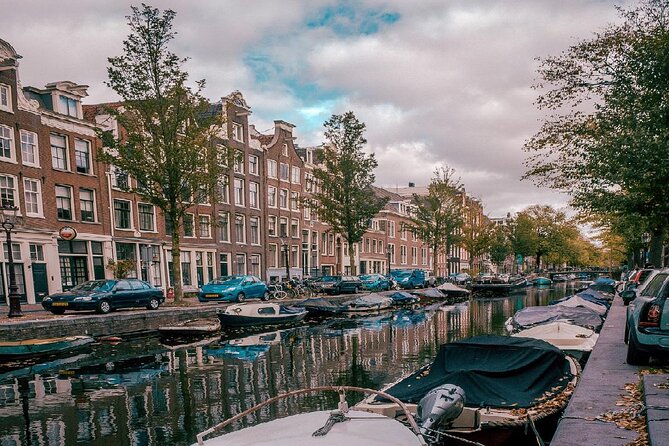
- UNESCO Canal Ring views from the water, without slow stop-and-stare pacing
- A tight route with many landmark moments in about an hour
- Big-picture + detail scenery: canal geometry, bridges, and housefronts
- Good comfort for a short cruise, even when the weather turns
- Audio clarity varies by seating, so choose your spot with care
Getting aboard: the Anne Frank House starting point
The meeting point is easy to find—right in front of the Anne Frank House. That matters more than you’d think. Amsterdam can be confusing when you’re juggling tram stops, side streets, and canal bridges, so starting at a landmark people already recognize makes the day run smoother.
This also helps your pacing. If you’re doing Anne Frank House, you can often build your schedule so the museum visit and the canal cruise work like one connected plan instead of two separate days.
You’ll use a mobile ticket (confirmation happens at booking), and the cruise runs in English. The group size is capped at up to 68 people, which keeps it from feeling like a tiny sardine can. Still, it’s a popular route, so go in with a calm mindset: find your seat fast and enjoy the ride.
You can also read our reviews of more boat tours in Amsterdam


Why a one-hour cruise works in Amsterdam (and what you won’t get)
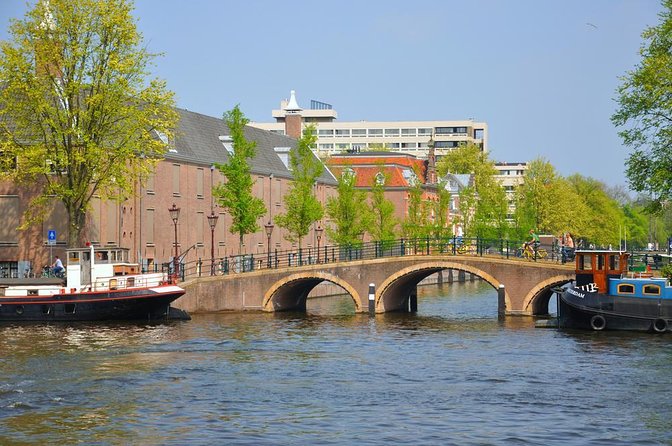
Amsterdam has two speeds: fast walking and slow museums. This cruise hits the fast speed. In about 1 hour, you get a moving overview of canal belts, river edges, and waterfront architecture.
That’s the main value. You’re not trying to “learn every canal house.” Instead, you’re getting a tour of sightlines. You’ll see how the city is laid out—where the canal ring sits, how neighborhoods connect across the water, and how buildings face the canals with almost theatrical consistency.
What you shouldn’t expect: a deep, slow, stop-by-stop historical lecture at every single building. Even with good commentary, it’s a short ride. If you want heavy detail, pair this with time at one anchor site (Anne Frank House is a strong match).
Museum of the Canals: starting with a sense of purpose
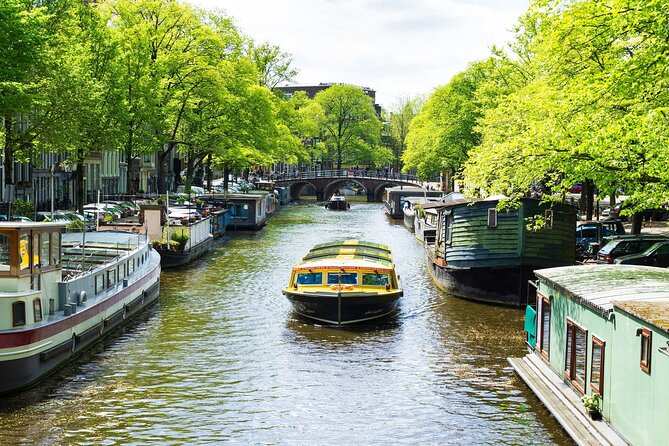
The route starts with a “look at the canals as the canals.” The cruise begins at the Museum of the Canals, which is a helpful warm-up. Before you see a hundred canal fronts, you get the idea that Amsterdam’s canals weren’t random decoration—they’re infrastructure, wealth, and power lines all at once.
This is the stop that sets context. When you later pass bridges and canal houses, you’ll understand why these water corridors matter. Without this quick framing, the whole thing can feel like pretty scenery only.
Anne Frank House from the water: the most important minutes on the route
Next up is the Anne Frank House area on the Prinsengracht. From the canal, you see the setting that shaped the famous story: the canal-side building style, the tight urban layout, and the quiet weight of a place that has become symbolic worldwide.
The details matter. The building is known for the Secret Annex (Achterhuis), where Anne Frank hid during World War II with her family and four others. Her diary was published in 1947, and the foundation was later created to protect the property from developers.
If you do nothing else on the trip, do this part with your full attention. You’re not getting a museum visit here—you’re getting the geographic feeling. That’s powerful.
Westerkerk and canal-belt streets: architecture you can read quickly
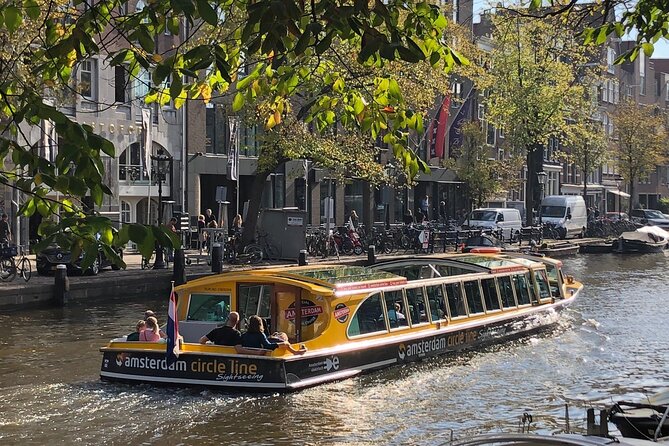
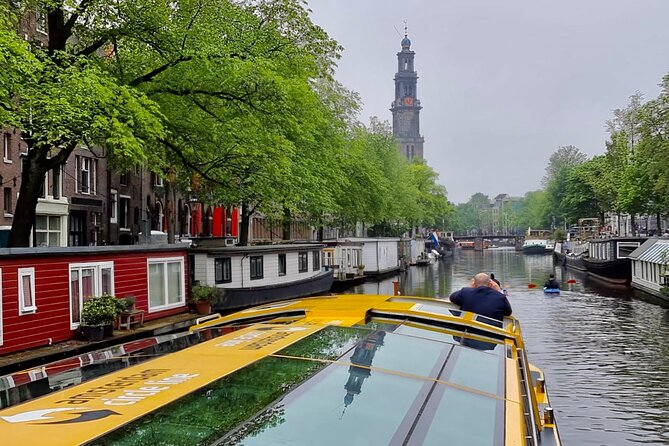
After the Prinsengracht focus, the cruise moves you into the broader canal belt world. A key sight on this loop is the Westerkerk, a Reformed church in Dutch Protestant Calvinism.
From the water, churches like this are almost made for canal cruising. Their edges rise cleanly above the houses, and you can understand the street-to-spire relationship that’s hard to grasp when you’re walking behind street lines. You’ll also see how the canal ring’s neighborhoods sit close together, with major landmarks placed so they’re visible from multiple angles.
This is also where the cruise earns its “time-saver” label. You get landmark-to-landmark continuity without negotiating bridges on foot.
You can also read our reviews of more city tours in Amsterdam
Houseboat Museum: a rare canal-life perspective
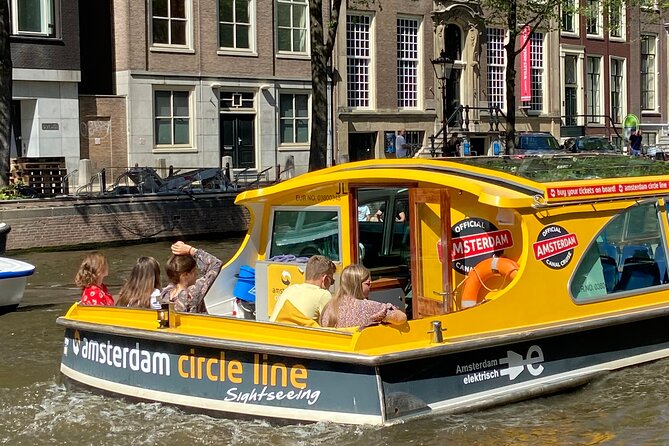
One of the standout moments on this type of cruise is the Houseboat Museum stop. You get to see what it looks like to live on a canal houseboat style—housed in the Hendrika Maria, a former cargo ship built in 1914.
This is where the cruise can surprise you, because it shifts the story from “buildings” to “daily life.” A canal houseboat isn’t just an architectural novelty. It’s a whole way of living with practical comforts, and the museum layout makes that clear.
If you’re the type who likes human-scale details, this is one of your best moments on the ride.
Leidsegracht, De Beulingsloot, and the canal “grid”
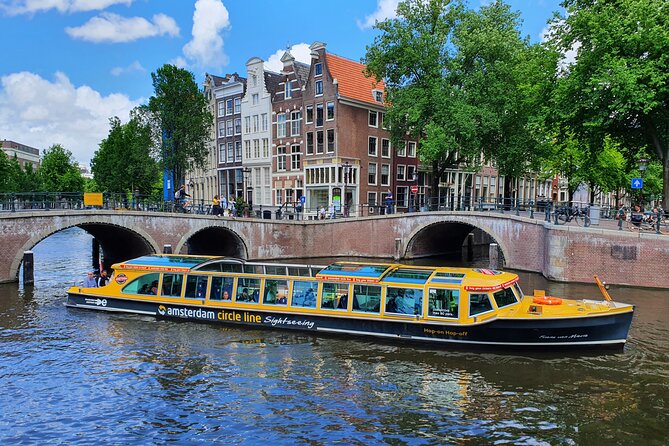
The cruise also hits smaller canal segments that show you how Amsterdam’s waterways connect like a network. You’ll pass Leidsegracht, a cross-canal linking major canals and flowing toward Singelgracht.
You’ll also see De Beulingsloot, described as one of the oldest and shortest canals in the center. That kind of canal is a reminder: the canal system isn’t just for big views. It’s also for the tight, historic fabric of the city.
This section is especially useful if you’re trying to figure out where you want to walk later. After these canals, you’ll start recognizing “how to get there” by sight.
Bartolotti House and historic canal houses: what to notice
The cruise passes the Bartolotti House, a canal house built around 1617 for Willem van den Heuvel tot Beichlingen, one of the richest Amsterdammers of the time. It also ties to a merchant from Bologna, Giovanni Battista Bartolotti, via inheritance.
From a boat, you’re not reading every inscription, but you can still spot why buildings like this mattered: the width, the façade rhythm, the position on the canal, and the way the home faces both water and street.
Here’s what I’d look for if you want to “get more” out of the short ride:
Watch the spacing between canal houses and compare it to where bridges interrupt the line of sight. Amsterdam’s historic wealth shows up not only in grand buildings, but in the consistency of the built edge.
Melkmeisjesbrug: the milk bridge story and why bridges matter
You’ll pass Melkmeisjesbrug, a fixed bridge in Amsterdam-Center with a long timeline on maps. The modern version replaced a pedestrian drawbridge in 1883, and later changes were made with a steel version in 1966.
It’s named after a milk market that used to happen nearby, with signage tied to a milkmaid. That’s the kind of detail that makes the canals feel specific instead of generic.
Bridges are also how Amsterdam reveals its engineering. You can see how the city adjusted passages when shipping patterns changed, and how narrow routes shaped design decisions. Even in a short cruise, bridges are like visual checkpoints.
Brouwersgracht and the borders between neighborhoods
Another canal segment on the route is Brouwersgracht, which connects Singel with Singelgracht and forms the northwestern border of the Grachtengordel. Between Prinsengracht and Singelgracht, it marks the northern border of the Jordaan neighborhood.
This matters because your brain maps neighborhoods by boundaries. When you see a canal acting like an edge, you’ll remember which side of the water belongs to which vibe.
Brouwersgracht also earned a reputation as one of Amsterdam’s most beautiful streets in a readers’ vote. You don’t need that for the experience, but it lines up with what you’ll notice from the boat: the canal-edge view is visually strong, even without stopping.
Posthoornkerk and the church-to-concert-hall transformation
One of the church highlights on the cruise is Posthoornkerk, designed by P.J.H. Cuypers and built to replace the earlier hidden church De Posthoorn on the Prinsengracht.
It was built in stages, including choir/transept/tower/nave between 1860 and 1863, then a two-tower front from 1887 to 1889. The reason it’s extra high is practical: it couldn’t be built fully free-standing, so space was optimized with galleries inside.
Also on the broader route is another historic church with a long life cycle: designed by Adriaan Dortsman, opened in 1671, rebuilt after damage, and later turned into a concert hall. The organ work and later restoration events tell you something important about Amsterdam: buildings don’t always stay fixed in one role.
If you’re a “why do buildings change?” person, this is an eye-opener. The canal view helps because you see both exterior character and the sense that the structure has been repurposed over time.
Amsterdam Centraal and the IJ: moving into modern waterfront views
The cruise doesn’t freeze you in the 1600s. It brings you toward the Amsterdam Centraal area, designed by Pierre Cuypers (also known for the Rijksmuseum). Cuypers is believed to have focused heavily on decoration, while structural design was handled by railway engineers.
Then you glide across the IJ, Amsterdam’s waterfront body of water. This shift is a good mental break. After canal houses and bridge details, the IJ gives you open space and bigger architecture.
One of the most distinctive buildings here is the EYE Filmmuseum, designed by Delugan Meissl Associated Architects. The architecture alone makes it a strong “modern Amsterdam” photo moment, even if you don’t step inside.
Amstel river viewpoints: Hermitage Amsterdam and Stopera
You also come around to the Amstel river, a major Amsterdam waterway tied to annual events like Liberation Day concerts and rowing competitions.
On this section, you pass Hermitage Amsterdam, a branch museum linked to the Hermitage Museum in Saint Petersburg. It’s housed in a former Amstelhof building from 1681, with exhibition spaces designed to bring collections forward for more people.
And you’ll see Stopera, the building complex that houses Amsterdam city hall and the Dutch National Opera and Ballet. The name Stopera comes from the protest slogan Stop the Opera, not from a shortcut meaning of city hall and opera—nice detail, because it tells you how people fought over public culture.
From the water, these aren’t just buildings. They’re proof that the canals and rivers are still used as a public stage.
Comfort, sound, and the “seat choice” that changes everything
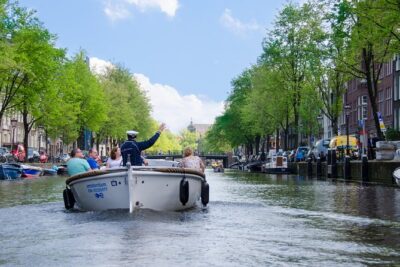
This cruise generally feels smooth and comfortable. People mention that even in cold and windy weather, it’s enjoyable, with an option to stay inside or outside.
But sound is the big variable. Multiple people reported trouble hearing the narration or noted that the switch between languages can be abrupt without a pause. There’s also feedback about the separate voice-over system not being loud enough in certain positions.
Here’s my practical tip: if you’re choosing seats, prioritize what you care about most.
If you want maximum unobstructed views (including from the rear), keep in mind that you might lose some audio clarity. If you want the full commentary, sit where you can clearly hear the voice-over system.
Also note names from the experience when you’re reading staff stories. Reviews mention captains and guides like Robert and Roli(f), with one person specifically calling out Captain Rolif as informative and entertaining. That’s a good sign when you get an especially strong narrator on your departure.
Price and value: $18.71 for a 1-hour “see-it-all” loop
At $18.71 per person, this cruise is priced like a practical orientation tool, not like a museum ticket. You’re buying time efficiency.
For that money, you get:
- quick canal-belt context near Anne Frank House
- multiple landmark sightlines in one ride
- views you can’t easily replicate from the street
If you only have a day or two in Amsterdam, the cost feels fair because you’re not paying for a single building. You’re paying for a moving overview that helps you decide what to do next.
Just don’t treat it as a replacement for the main sites. The Anne Frank House stop is about setting and location, not ticketing inside the museum.
Who should book this cruise (and who should pair it)
This is a smart fit if you:
- want an easy first-day plan
- like architecture and canal layout
- need a low-effort way to cover lots of sights in a short window
It’s also a good choice for people traveling solo, since the cruise vibe tends to feel relaxed and not overly chaotic. Families can work with it too; one review even mentioned a one-year-old having a good time.
If you’re the type who needs constant live narration, you may want to be cautious. Some comments point out that not every departure delivers detailed building-by-building explanation, and hearing the recorded commentary can be tricky.
Should you book this Amsterdam Circle Line canal cruise?
I’d book it if you want a high-output sightseeing hour with a clean starting point. The Anne Frank House location is convenient, the Canal Ring views are the right kind of “worth the photos,” and the route hits both historic canal scenes and modern waterfront landmarks like the EYE area.
I wouldn’t call it the best option if your top priority is detailed, perfectly audible commentary throughout. To get the most from it, sit where the narration is easiest to hear, and treat the cruise as an orientation tool you can build on with walking and museum time.
FAQ
FAQ
How long is the Amsterdam Historic City Sightseeing Canal Cruise?
It’s about 1 hour.
Where do I meet for the cruise?
The meeting point is in front of the Anne Frank House, and it’s described as easy to find.
Is the tour offered in English?
Yes, it’s offered in English.
How do I get my ticket?
You’ll have a mobile ticket, and you receive confirmation at the time of booking.
What’s the price per person?
The price is $18.71 per person.
How many people are on the tour?
The experience has a maximum group size of 68 travelers.
Are service animals allowed?
Yes, service animals are allowed.
Is there free cancellation?
Yes. You can cancel for a full refund up to 24 hours in advance of the experience’s start time.